FEASTING · Part V · The Feast
Chapter 18
The Village
Draft 1, 25 September 2026 · 9,806 words · 5 movements
The Opening
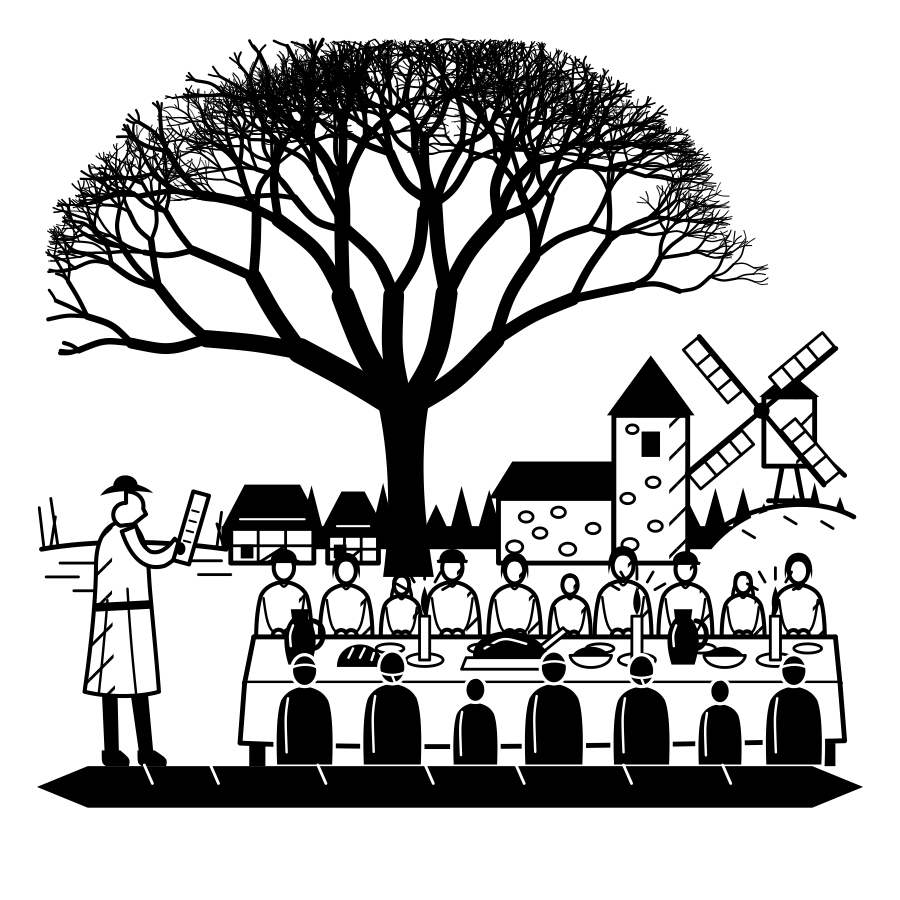
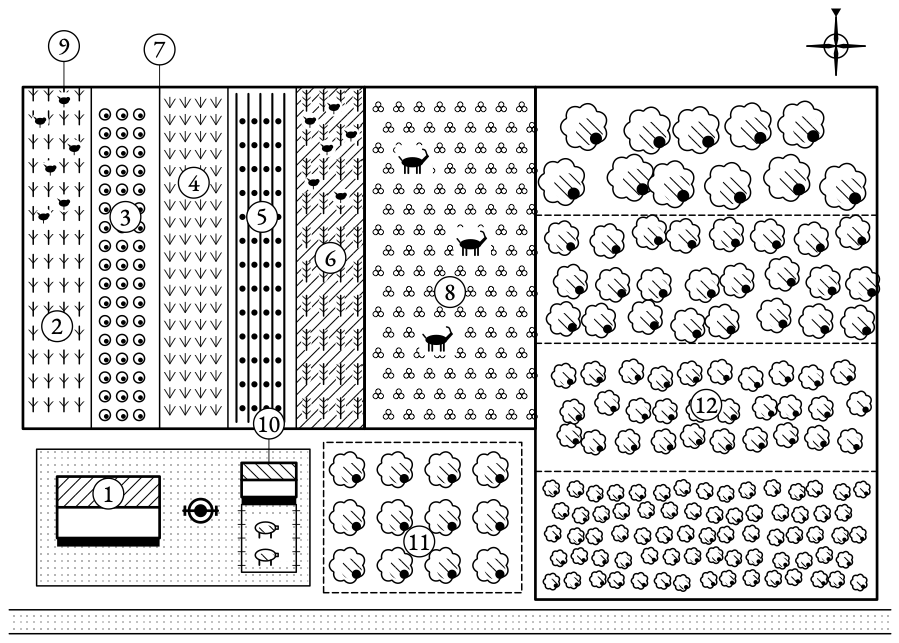
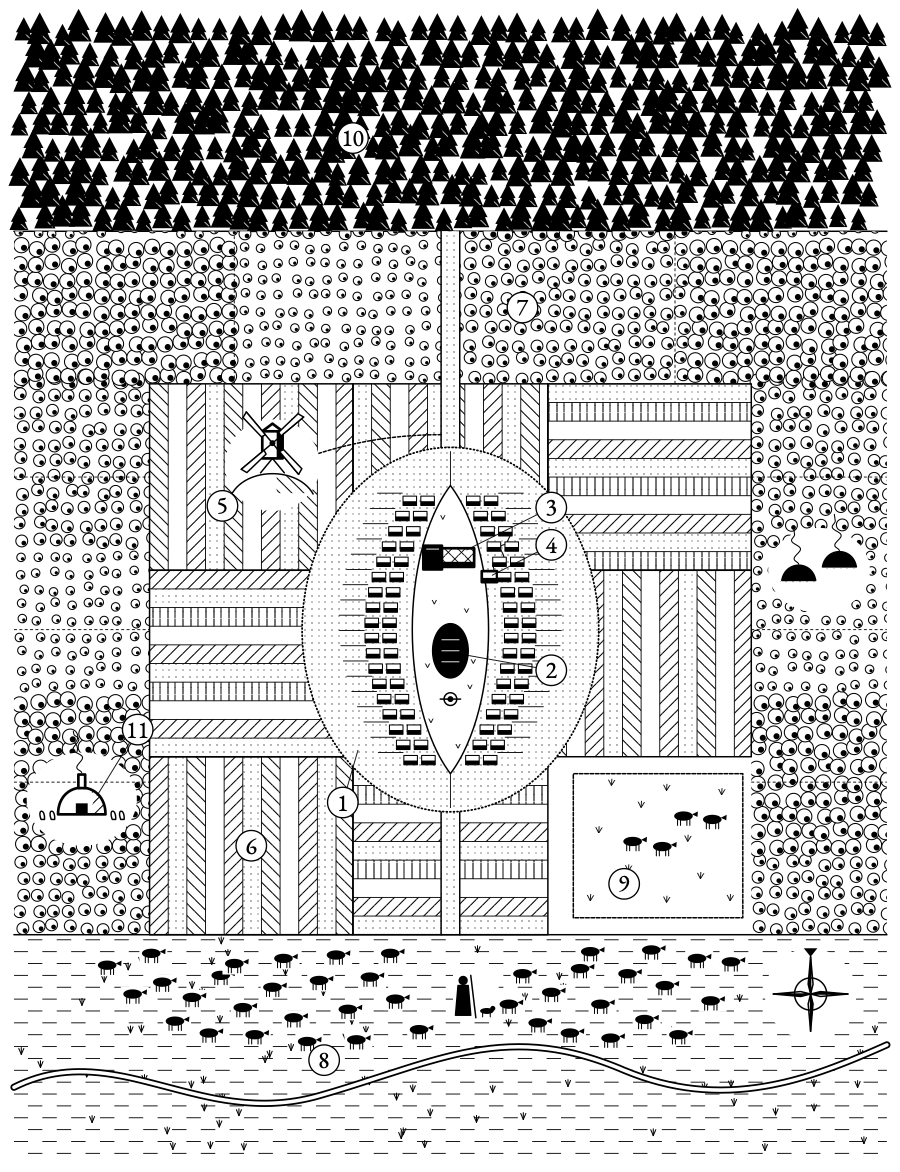
The villages of the Mark are built where they are for a reason you can see from the church tower. Look down and the houses stand on a low rise of sand, the fields run out from them in long strips on the sand, and beyond the fields, where the ground drops a metre and turns dark, the meadows begin, the Luch, wet in winter and hay in July, and the cows are out there in one herd under one herdsman. Nobody planned this. It is what happens when a few dozen families try to live on ground that grows rye badly and grass well, and it is the shape the numbers make when they are all put together, which is what this chapter is going to do.
Take a pencil. Every chapter so far has left a figure on the table, and they have not been added up. The hearth wanted seven and a half tonnes of beech and a hectare and a half of coppice. The garden wanted a thousand square metres and no irrigation. The rye wanted twelve hundred, and the cow wanted two hectares of grass that the family does not own. The salt came to a hundred and twenty-eight kilos, the roof caught seventy cubic metres of water, and the smith, the cheesemaker and the potter were each told to wait for a village. This chapter is the reckoning. It asks how much land a family of four needs on Brandenburg sand, and the library's answer is a hectare and a half and Chapter 8's is three, and both are right. It asks how many hours the year takes and where they pile up, and finds three narrow places in the calendar where one household cannot be in two fields at once. It asks how many hours the tools take before a furrow is cut, and how much water the household and its animals drink, and where the water comes from when the roof is not enough. And then it asks the question the book has been putting off since the Preface, which is how many people it takes before anyone can be a smith and nothing else, and the answer is about three hundred, and the reason for the answer is a story about who does the cooking. Three economists told that story in the last century, one of them was shot for it, and the chapter ends with them.
The opening of the chapter. It goes on in the book.
The Story
- The reckoning
- A hectare and a half
- The year and its three narrows
- Four weeks at the grindstone
- Water
- The threshold
- Three economists and who cooks
- The Honest Broker's village
- The turn to the present
6,671 words in the book.
At the Bench
This Bench has no fire in it. It is paper, a pencil, a tape, a spade and a walk, and the one danger in it is the well.
1 The household's reckoning, on one sheet
2 The year on one sheet Safety
3 The tools' year, and the quern
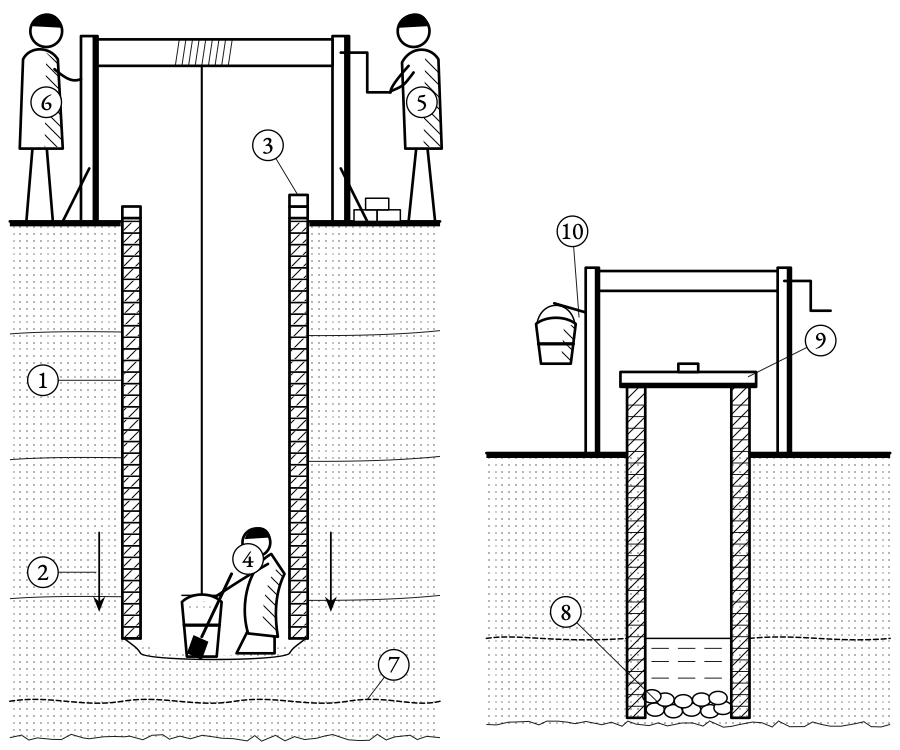
4 The well Safety
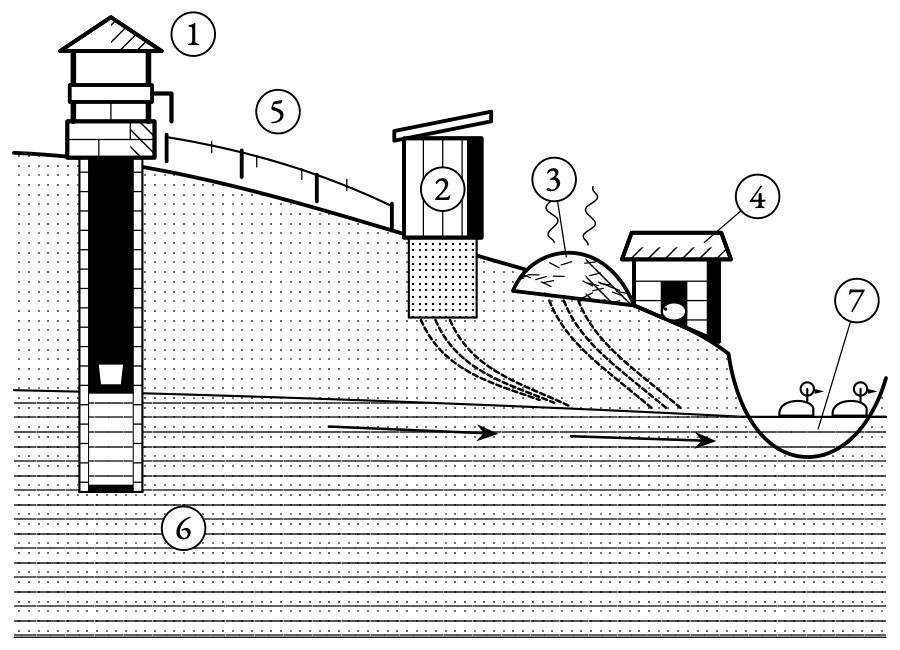
Never dig an unlined hole deeper than your waist in sand. Sand collapses without warning and kills the digger in seconds. The well is lined as it goes down, ring by ring, or it is not dug.
5 Counting to three hundred
6 The boon-day
If it goes wrong
The first lines of each protocol. The steps, weights and temperatures are in the book.
Numbers to Carry
- 4,000,000 kcal a year for four. 2,740 a head a day.
- 1.5 ha of the household's own: 1.0 arable in five blocks, 0.5 clover. Plus 1.5 ha of coppice. Plus, for a cow, 2.7 ha of grass that is the village's.
- Gross 10,000,000 kcal from the 1.5 ha at sand yields. Net after hens, seed and the bad year, 5,400,000.
- A loaf a day, ten kilos of potatoes, six litres of goat's milk, eight eggs, a pig a year.
- Medieval yields multiply the land by sixteen. Keep the seed modern.
- The household's year: about 4,000 hours, of which the kitchen is 1,100, the field 1,500 to 2,000.
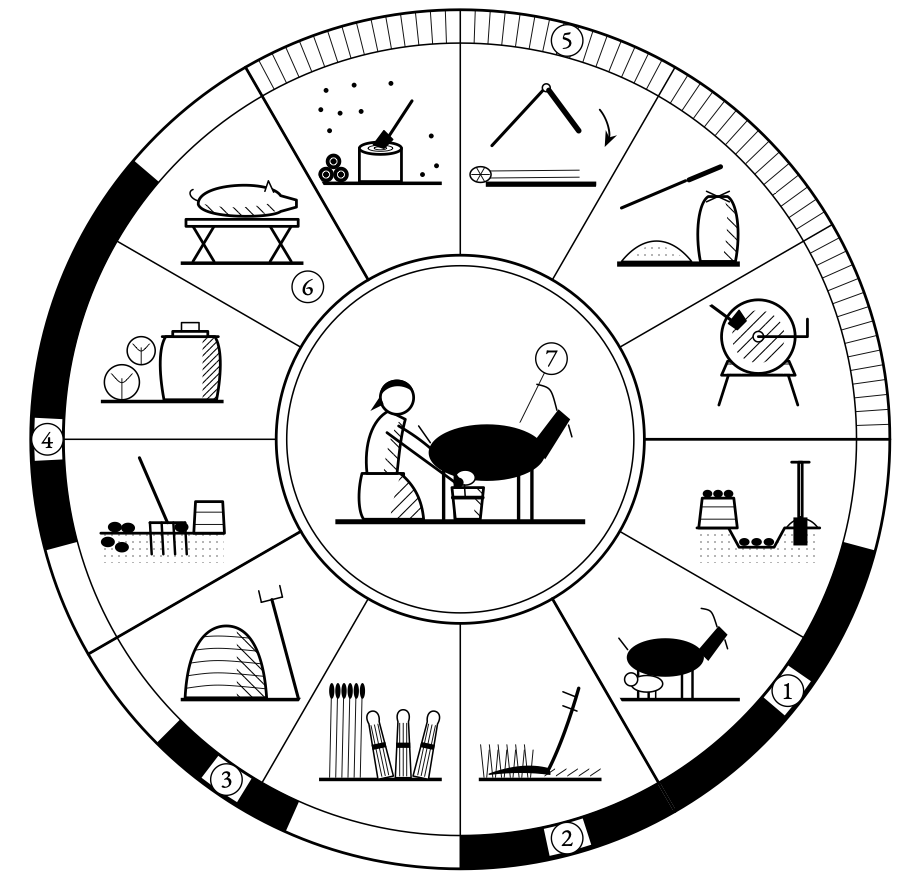
- Three narrows: mid-April to end of May, late July to mid-August, mid-September to 11 November.
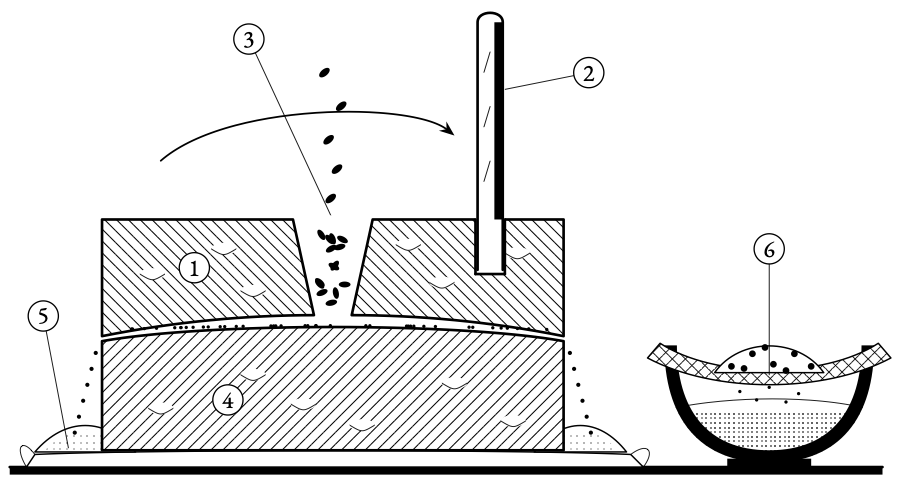
- Tools: 156 h a year, of which the stone is 35. The quern: 200 to 300. A file lasts one to three years.
- Water: 50 l a person, 60 to 100 a cow, 5 to 10 a goat, 8 to 15 a pig, 0.3 a hen, 20 to 40 the dairy. 300 to 400 l a day for the household with its animals. The roof gives 70 m³ a year. The rest is the well, at 12 l a lift.
- Well: 30 m uphill of the privy. Lined as it goes down. Never alone.
- Threshold: 50 to 60 households, about 300 people. 40 cows is a herdsman, 30 households' grain is a mill, 50 households is a smith, a 50-cow herd is a cheesemaker.
- Land for 300 on sand with modern seed: about 300 to 400 ha. With medieval seed, 1,400.
- A farming household grows a tenth to a fifth more than it eats. Ten households feed a specialist. Twenty feed him in a bad year.
- Chayanov 1888 to 1937, book 1925. Boserup 1910 to 1999, books 1965 and 1970. Brenner 1976. Hagen 2002.
The Library
The chapter draws on five documents in the research library, none of which has been verified against primary sources:
- 117, Minimum Acreage for Family Sustenance. The 4,000,000 kcal budget, the 30/30/40 ratio, the 1.5 ha of arable and clover, the five blocks, the three goats, twelve hens and two pigs, the sand yields, the calorie table, the buffers and the 5,400,000 net, and the 1,500 to 2,000 hours. Half its citations are the rotation study Chapter 6 used, and its diet and calorie figures are from fitness blogs and a protein shop.
- 131, Micro-Community Size and Specialisation. The 60 to 80 acres per medieval household, the seed ratios, the 14 t of wood, the surplus ratio, the smith's charcoal, the cheesemaker's milk, the 60 households, 300 people, 3,450 acres and five specialist households, and the summaries of Chayanov, Boserup, Brenner and Hagen. Its numbers come from forums, a school site, a mailing-list post and a tree nursery, and it attributes its model to 121, which does not contain it.
- 121, Temperate Agrarian Labour Calendar. The shape of the year, the boon-work and reciprocal labour, the week-work, Martinmas, and the preservation chemistry that Part Four already used. No numbers. Its social history is from an artificial wiki.
- 120, Agri-Culinary Tool Inventory. The steel classes from the library's own scavenging report, the tool inventories, the lifespans (scythe 5 to 15 years, files 1 to 3, gasket 1 to 3, barrels 10 to 30, axe heads indefinite), the maintenance routines and the 156.5-hour sum with its nine lines.
- 122, Water Demand and Catchment Scale. An industrial canteen and dairy plant. Its roof yield (591 mm × 0.9 × 0.9 = 479 l/m²/yr) confirms Chapter 5. Its farm figures are cited to an unknown address and its closing arithmetic is wrong. Nothing else in it is household-scale.
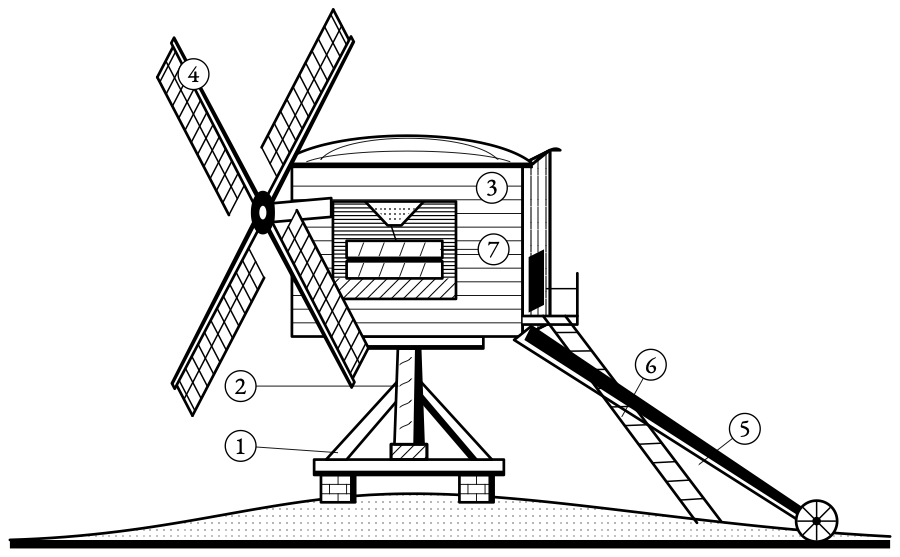
The Luch and the sand islands, the Hufe and the Morgen, the kitchen's hours, the milking hours, the narrows' hours, the quern and the post mill and the Mühlenzwang, the litres for people and animals, the well and its rules, the order of the specialists, the book's own village of 300 to 400 ha, and the dates and arguments of Chayanov, Boserup, Brenner and Hagen are the book's own and are marked.
The plates