FEASTING · Part I · Fire and Iron
Chapter 4
Copper, Wood and Stone
Draft 2, 25 September 2026 · 8,721 words · 5 movements
The Opening
The spoon in the pot is wood, and it is the oldest thing in the kitchen. Older than the pot, older than the knife, older than the fire in the shape it has now. It was a tool before there was metal, and it has outlasted every metal fashion since, because nothing else is soft enough to spare the pan, hard enough to turn a stiff dough, and cheap enough to lose. Every kitchen has one. Most have five in a jar, and the one on top is the one that gets used.
Take it out of the pot for a moment and look at the bowl. One side is worn flat, at a slant, where twenty years of the same hand pressed it against the wall of the same pot, and the wood there is dark and glassy with fat and heat. The other side is still nearly round. Turn it over, and the handle has a dent where the thumb sits. The spoon has taken the shape of the hand that used it and of the pot it was used in, and it did that slowly, without anyone meaning it to, the way a path forms across a field. The wood remembers.
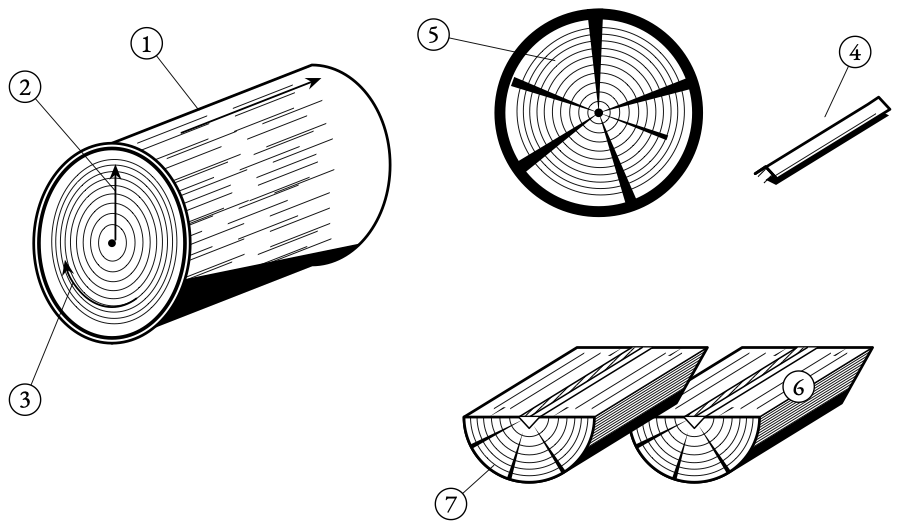
Three materials in the kitchen are not iron, and each of them remembers in its own way. Copper remembers every blow of the hammer that shaped it and keeps the memory as hardness, until after a few hundred blows it has remembered so much that it will crack rather than move again, and it has to go into the fire to forget. Wood remembers the tree. It was alive when it was cut, and it goes on drinking and drying for years afterwards, swelling in the wet and shrinking in the warm, and a spoon carved without regard for which way the tree grew will split along that memory in its first week on the hook. Stone remembers nothing and learns nothing. The pattern that grinds the flour has to be cut into it with a chisel, and the stone holds the pattern without change for five hundred hours of turning and then has to be taught it again.
The opening of the chapter. It goes on in the book.
The Story
- The metal that came before iron
- What the hammer teaches the copper
- Raising
- The tin
- The wood that is still alive
- The press
- The stone that forgets nothing
- The Honest Broker's machine
- The turn to the present
5,693 words in the book.
At the Bench
Copper is worked at the same charcoal fire as the steel, in the neutral zone above the blast, with the eyes covered and the quench water at hand, and the tinning is done outdoors with the wind at your back. No galvanised steel, no painted or soldered copper, and no cable insulation, ever, in the fire.
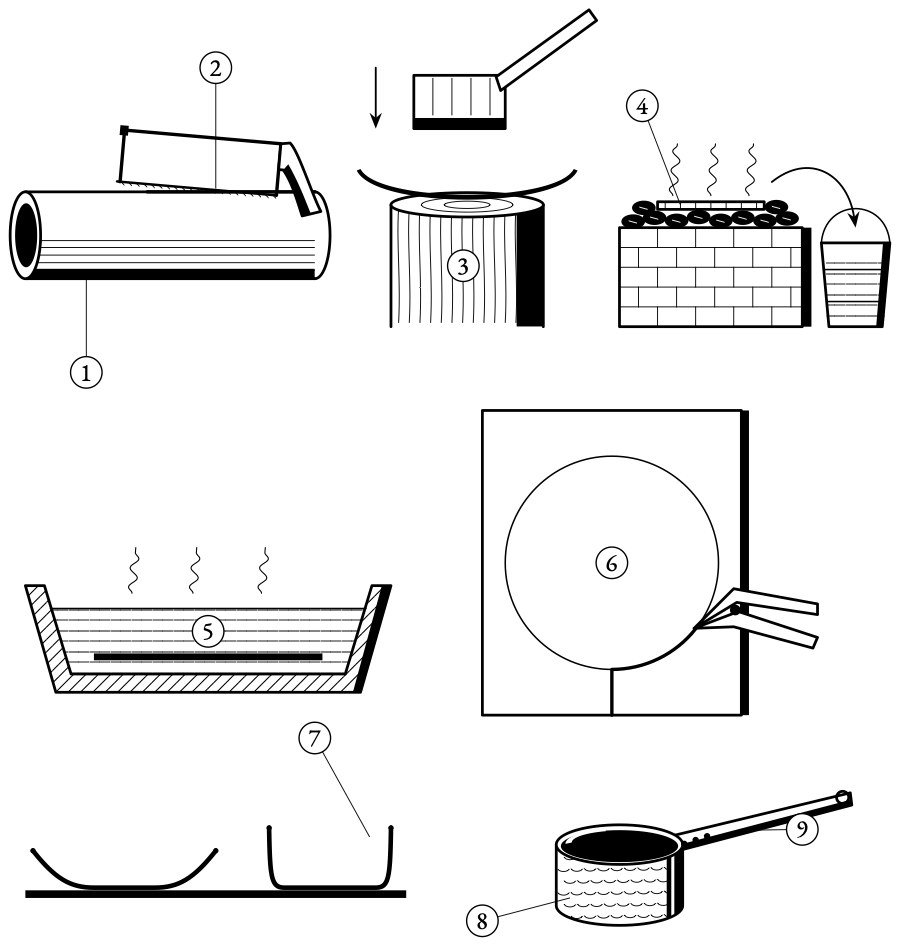
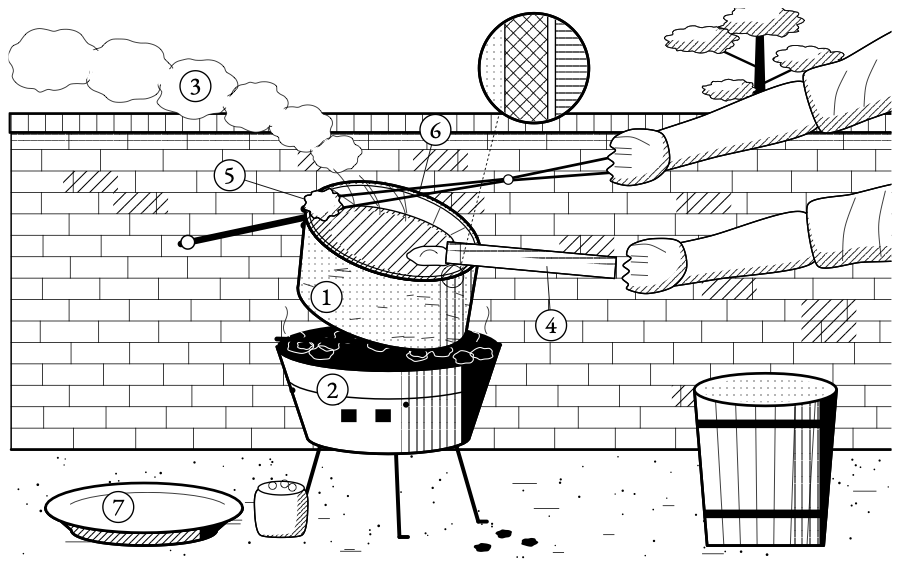
1 A saucepan from the pipe Safety
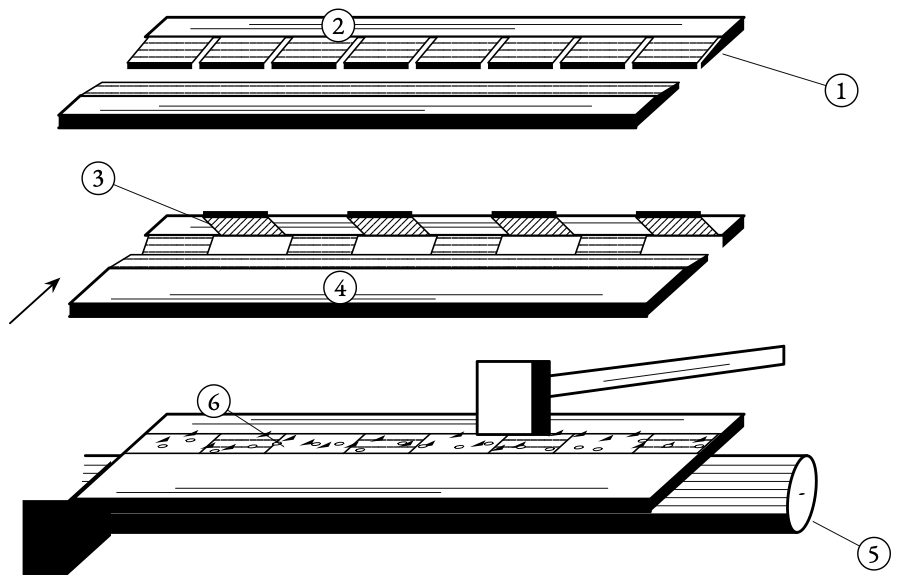
For a seam: feather both edges to half thickness over 15 mm. Slit one every 15 mm to the start of the taper, bend the tabs alternately up and down, slide the other edge in, hammer flat on a mandrel. Fuse borax to glass in a crucible first, grind it, spread it on the seam with chips of a cadmium-free silver alloy, heat until the flux runs clear and the alloy is drawn in. Pickle at once. Planish.
2 Tinning Safety
If pewter is all there is: new pewter, since the European standard of the mid-1990s, is tin with a little antimony and copper and no lead, and old pewter is often a fifth lead and ley metal more. Test a scrap before it goes near food. Weigh it in air and in water: anything denser than tin by more than one part in a hundred carries lead by the handful and is rejected. The weighing, the cry and the streak tell tin …
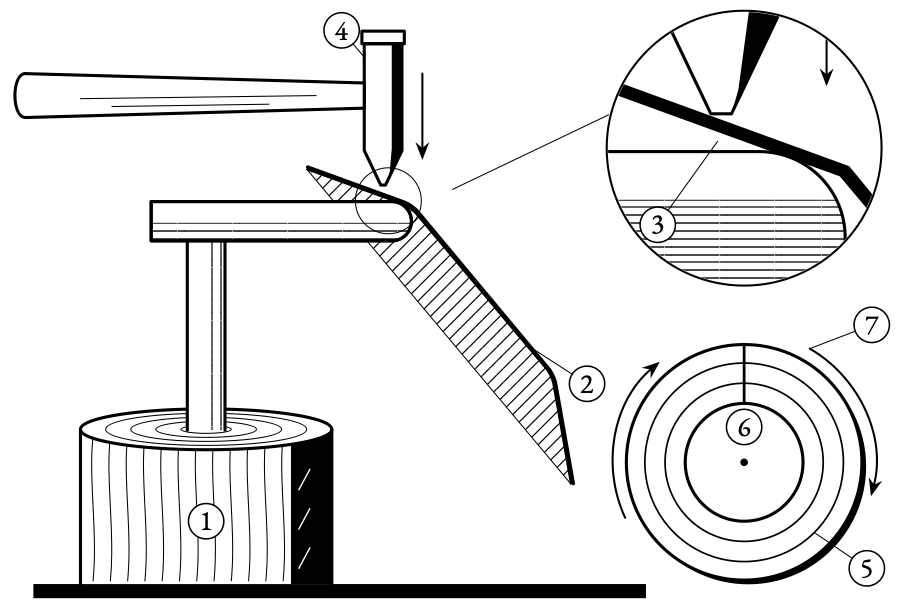
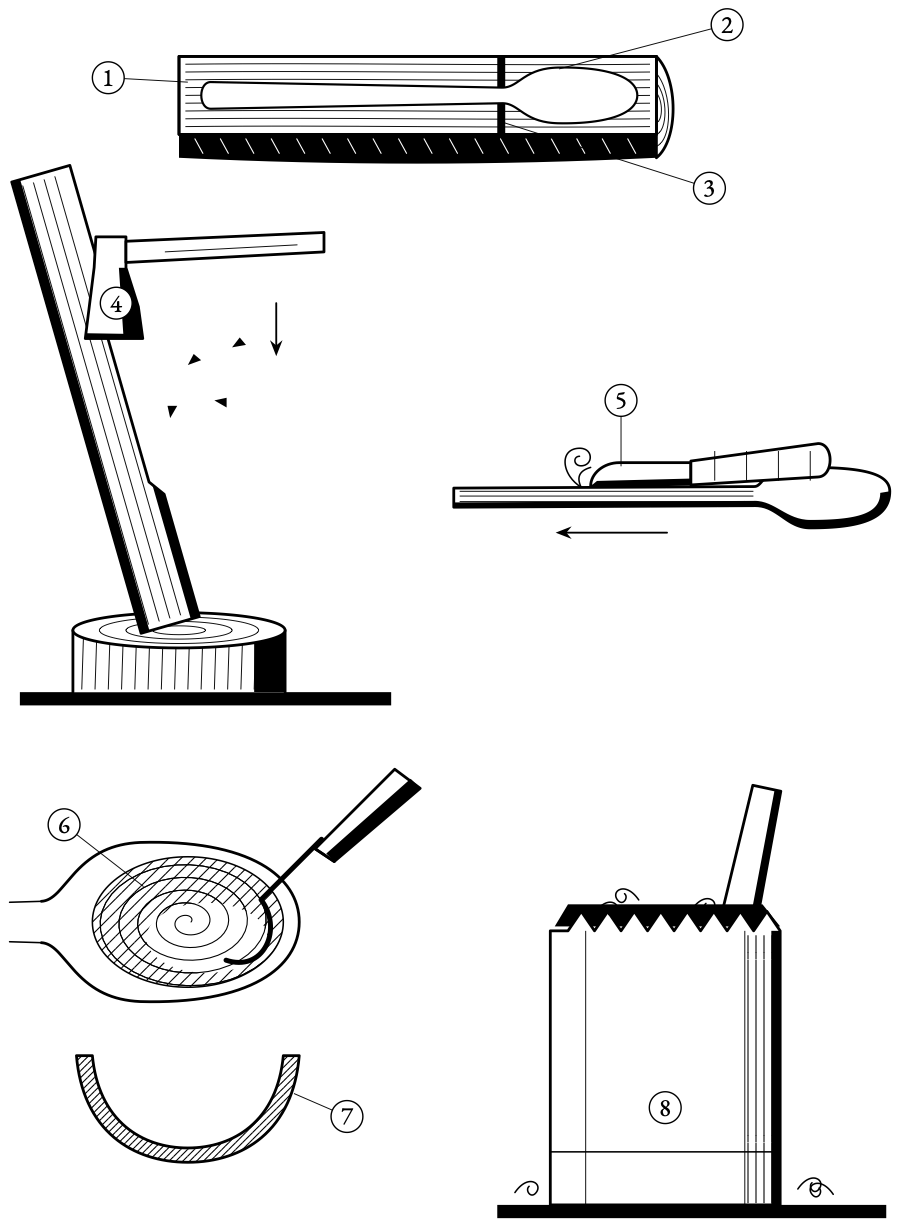
3 A spoon Safety
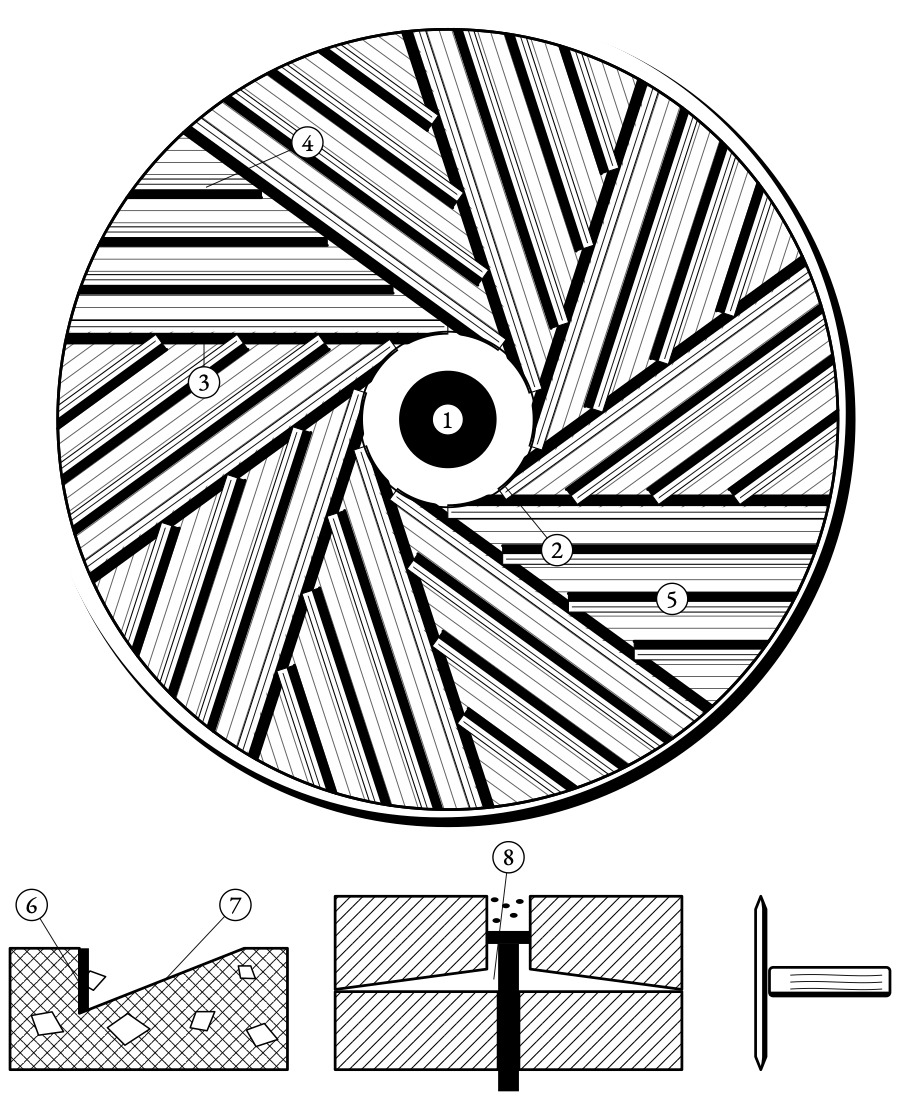
4 Dressing a millstone Safety
5 A batch of rapeseed Safety
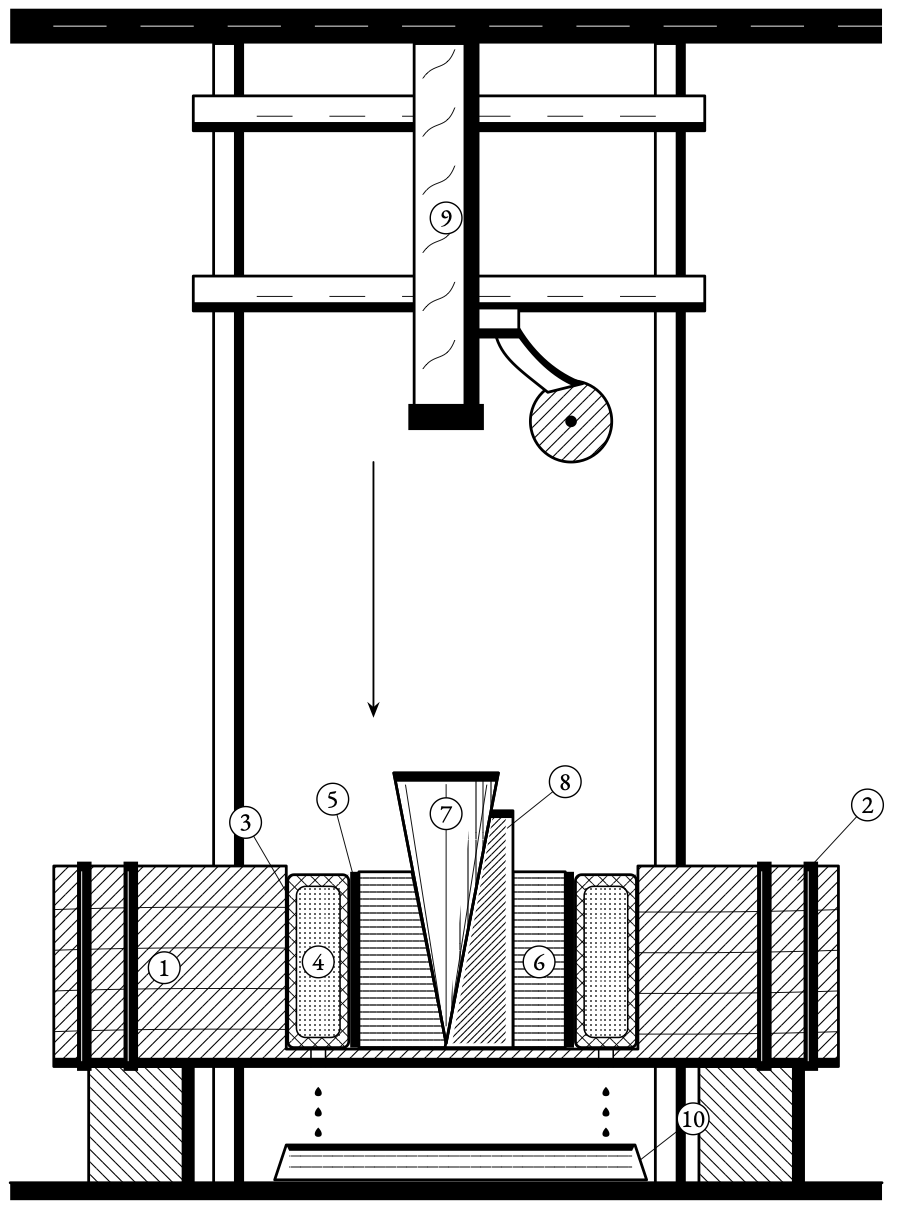
The beam press is a village machine. Numbers for the machine first, then the batch.
6 A dough trough
If it goes wrong
The copper tears at the rim. It was hammered past the ring, or the edge had a nick. Cut the rim back below the tear, file, anneal, and go on. Anneal sooner next time.
The first lines of each protocol. The steps, weights and temperatures are in the book.
Numbers to Carry
- Copper: soft at 60 to 90 MPa, hard at 250 after a round or two. Anneal at dull red, about 600 °C, quench, pickle at 60 °C. Pipe, never wire. Cut off every solder joint. 11 12
- Raising: stake at 20°, one round to the ring, twenty rounds to a kettle. Planish last and never anneal after. 12
- Tin: melts at 232 °C, wiped at about 250 to 280, half a millimetre thick, block tin 99.9 % or better, never quenched. Re-tin at a coin-sized patch. (14, the temperatures the book's own)
- Wood: saturated at 26 to 30 % water, kitchen-dry at 6 to 12. Shrinks 6 to 10 % round the rings, 2 to 5 across, 0.1 to 0.2 along. Ends dry ten to fifteen times faster. 18
- The press: beam 2.7 m by 0.6 to 0.7, wedges 10 to 12° a side and never over 19°, stamper 150 kg from 1.2 m, forty to sixty blows, 15 MPa. Rapeseed at 90 to 110 °C. Three to four kilograms of seed to the litre. (15, 22, the yield the book's own)
- The stone: 30 to 50 cm across, runner 20 to 50 kg, eye gap 3 to 4 mm, furrows 6 to 19 mm deep, 3 to 6 cracks to the inch for bread, redress at 200 to 500 hours, flour under 38 °C, 75 W at 50 to 60 turns. 16
- The machine: 27 hp, 200 bar, two and a quarter tonnes, and every seal bought. 8 9 10
- Pewter: new is tin with a little antimony and copper. Old tavern ware is up to a fifth lead, ley metal more. Plumbing solder from before the late 1980s is half lead. Weigh it in water, bend it for the cry, streak it, melt a corner (tin 232 °C, lead solder 183): these find heavy lead, not the trace the law allows, so unknown pewter never meets food. 147
- The trough: a log 50 to 60 cm by 1.2 m, walls 18 to 22 mm, four to six months to dry, 12.5 hours of work, 40 to 60 years of life, never lye. 143
The Library
The scrap grades, the two coppers and their embrittlement, the lead solder rule, the annealing and pickling, the JABOD forge and the rolling schedule from the cold-rolling document (11). The raising, the layout, the stake angle, the work-hardening figures, the planishing, the tin thickness and the Berlin coppersmiths from the kettle document (12), which cites 11 for its metallurgy. The cramped joint, the borax, the spelter and silver alloys and the cadmium warning from the joints document (13), which cites 12. The verdigris, the sal ammoniac, the block tin and the coin-sized patch from the tinning document (14), which cites 13, so that 11 to 14 are one chain and one witness. The copper sulphide and the lute recipes from the alembic document (17). The hornbeam, the Dutch beam, the wedge angle, the stamper, the pressures and the ejection hazard from the two press documents (15, 22), of which 22 cites 15. The granite minerals, the Lausitz and the Findlinge, the ring test, the harp, the furrow depths, the stitching, the redress interval and the silica limits from the mill document (16). The shrinkage figures, the species, the tools, the drying, the oils, the rag fire, the Cliver and Yadav findings from the green-wood document (18). The tractor, the workshop and the harvester from the three open-source machine documents (8, 9, 10), of which 9 and 10 cite 8. The hot-dip tin bath, the pewter grades and the lead assay, the horsetail burnish and the drying time for a spoon from the cutlery document (147, read for draft 2 on 25 September 2026), which cites 11 and 14 and takes its pewter from a document-sharing site. The dough trough, the shrinkage table by species and the wet-wood softening point from the cooperage document (143), whose figures for sycamore and oak differ from 147's by up to two parts in a hundred. None of these is verified, and every temperature in 12, 13, 14 and 17 was lost in extraction and has been supplied from my own knowledge. Ötzi, Mansfeld, the Kupfergraben, the jam pan, the copper bowl, Villedieu and 1830, Pliny and Alesia, Theophilus, the Kesselflicker, the tin's melting point and the tinning window, the empty-pan rule, sycamore, Sundqvist, the Wisconsin date, the Spreewald linseed, the oil yield and the family's thirty litres, Vitruvius, the post mill and Sanssouci, the roller mills of the eighteen eighties, the flour per hour, the wood-gas lorries, the pan's two hundred years, the Kurfürstendamm window and every dimension at the Bench that the library does not give come from my own knowledge and are marked.
The plates