FEASTING · Part II · Soil and Seed
Chapter 6
The Five-Year Conversation
Draft 2, 25 September 2026 · 13,340 words · 5 movements
The Opening
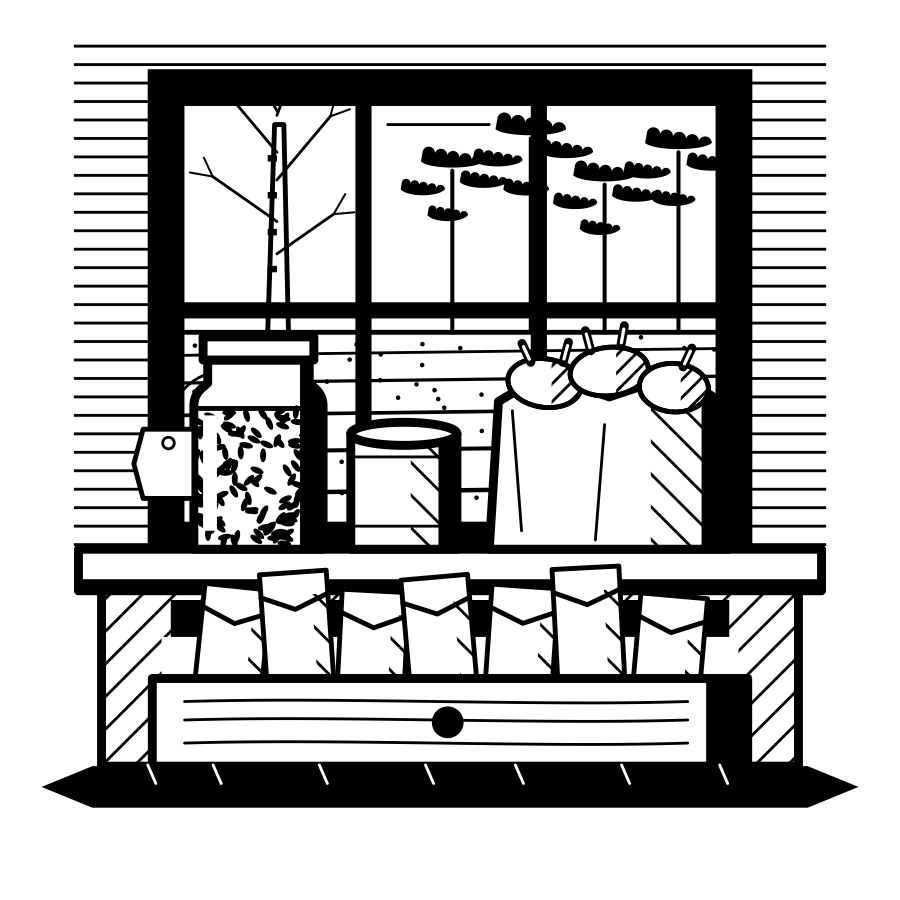
In February the garden is a drawer. Paper packets with last year's writing on them, a jam jar of rye with a label, a tin of beans, a paper bag of seed potatoes going green on the windowsill because someone put it there on purpose. Nothing is growing. Everything is being decided. And the question that every gardener asks the drawer in February, which is what goes where this year, turns out to be a question about last year, and the year before, and the year before that.
Because the ground remembers. Not the way copper remembers a blow or wood remembers the tree, but the way a person remembers a conversation: by what was said last. Put cabbages where cabbages were and the ground answers with clubroot, a swelling of the roots that comes from a spore that waits in the sand for twenty years. Put potatoes back too soon and it answers with black scurf. Put carrots straight after rye and they come up thin and few, because the rye left something in the soil that stops small seeds. Say the same thing twice and the ground stops listening. The old farmers of the sand knew this without a word for it, and then they got a word: Fruchtfolge, the succession of fruits, and a rule that went with it, which was that you spoke to a field in turns and let it speak back.
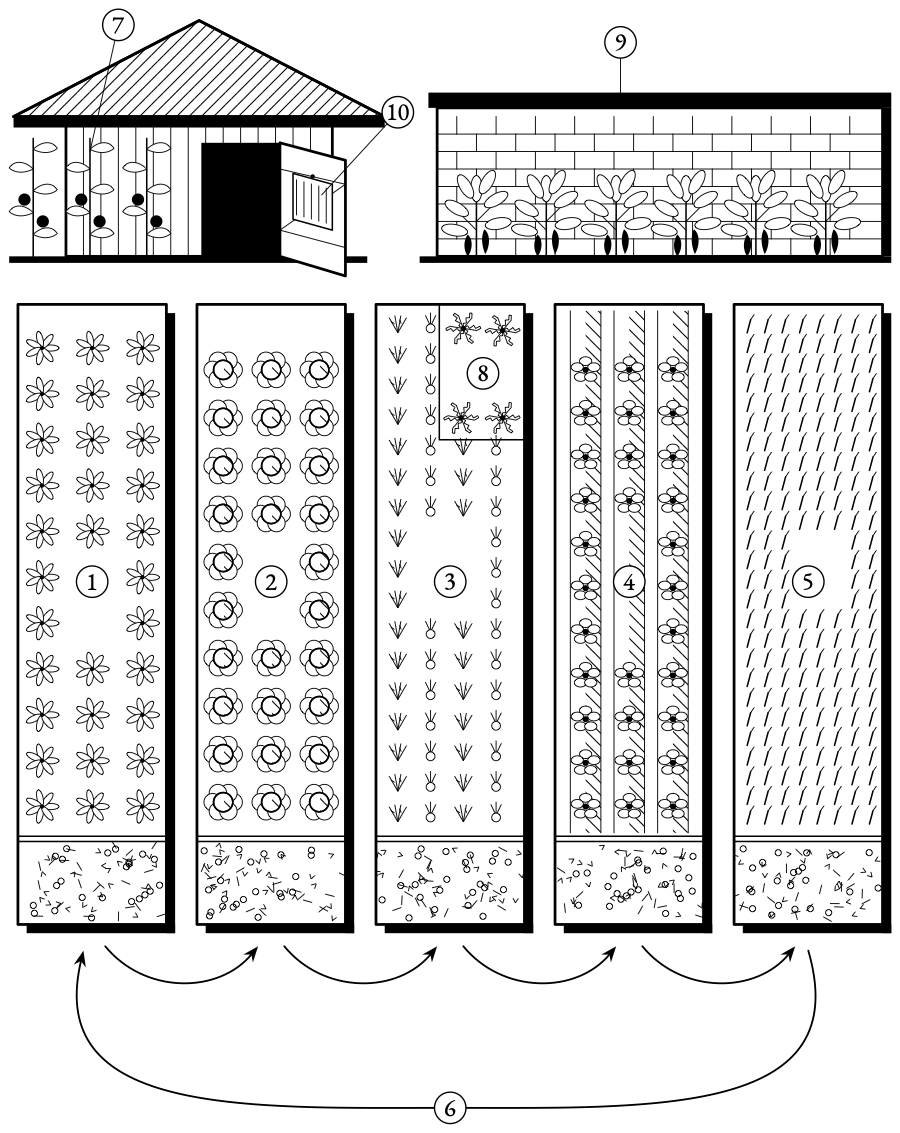
This chapter is about the turns. There are five of them on Brandenburg sand, in the order the library gives and the order the ground prefers: the lupin, which asks nothing and leaves nitrogen behind. The cabbage, which eats what the lupin left. The carrot, which wants a fine bed and no fresh dung. The potato, which pays for itself and costs the soil dearly. And the rye, which is bread, and which closes the sentence and starts the next. Around those five the rest of the garden is arranged: the beans and the chickpeas that came from the Fertile Crescent and are not sure about the Brandenburg summer, the tomatoes under the eaves, the beet that Berlin turned into sugar, the paprika and the coriander that can be grown here and the cumin that mostly cannot, and the chicory root that Prussia drank for a hundred years when coffee was a crime. And at the end of the chapter, because a conversation about bread is a conversation about seed, the part nobody in a supermarket has done for three generations: keeping enough of the harvest to sow again, and keeping it sound.
The opening of the chapter. It goes on in the book.
The Story
- What the ground remembers
- The year the lupin speaks
- Cabbage, carrot, potato
- The garden beside the field
- The rye and the two wheats
- Flax, and the summer grains
- The pulses and the ones from far away
- Spice, and the coffee you will not drink
- Keeping the seed
- The scythe
- The Honest Broker's ox
- The turn to the present
8,810 words in the book.
At the Bench
Everything here is done with a spade, a fork, a rake, a line, a jar, a scythe and a thermometer for the hot-water bath. The dangers are the scythe's edge, the lye in the soap protocol and the quicklime in the seed jar, the hotbed's ammonia, the bitter squash, and the ergot, which is the one thing in the chapter that can kill from a plate.
1 Five beds on paper
2 Rye: sowing, keeping and cleaning Safety
3 Potatoes Safety
4 Harvest with the scythe Safety
5 A chicory roast Safety
6 A soap for aphids Safety
7 Onions from seed, and garlic
8 The hotbed Safety
9 Vegetable seed: the biennials and the tomato Safety
If it goes wrong
The cabbages wilt at midday and the roots are swollen and knobbed. Clubroot. Burn the plants. Lime that bed to above pH 7 and keep every brassica off it for six years.
The first lines of each protocol. The steps, weights and temperatures are in the book.
Numbers to Carry
- The rotation: lupin, cabbage, carrot, potato, rye. Five years between cabbages by the rotation document, six to seven by the kitchen-garden report, which the chapter keeps, and the bed limed to pH 7.2 or more. Three between potatoes, two between rye and carrots. Never mustard, never radish. 24 133
- The lupin: mid-March to early April, seventy to a hundred plants a square metre, seven grams of seed, 150 to 180 kg N a hectare by day 110. Rye and vetch by mid-September. 24
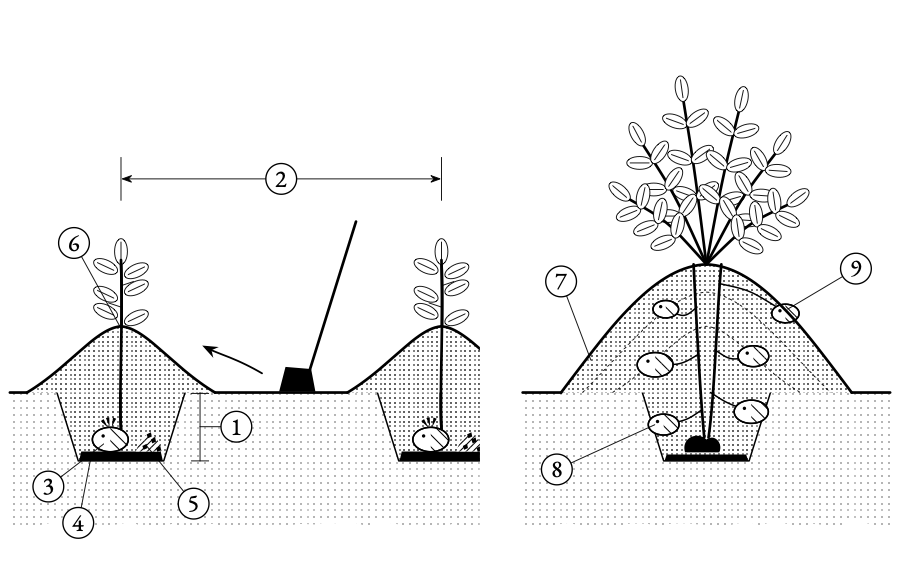
- Potatoes: chit two weeks, plant mid-May, 10 to 15 cm deep, 30 cm apart, hill at 20 to 30 cm. Two kilograms a square metre, sixty kilograms a person, thirty square metres. Dark, always. (30, 127, the person's sixty the book's own)
- Rye: early to mid-September, 180 to 240 seeds a square metre, seven to nine grams. Three hundred grams a square metre off sand. Three hundred square metres a person, two kilograms of seed. (124, 127, the person's bread the book's own)
- Seed: rye from two hundred plants, 250 to 300 m from other rye. Wheat a metre. A hundred seeds at twenty degrees, eighty up in ten days, or two lots of fifty at a week and a fortnight. Keep double. Store under thirteen per cent, cold. Halves its life for every point of water or six degrees. 27 124
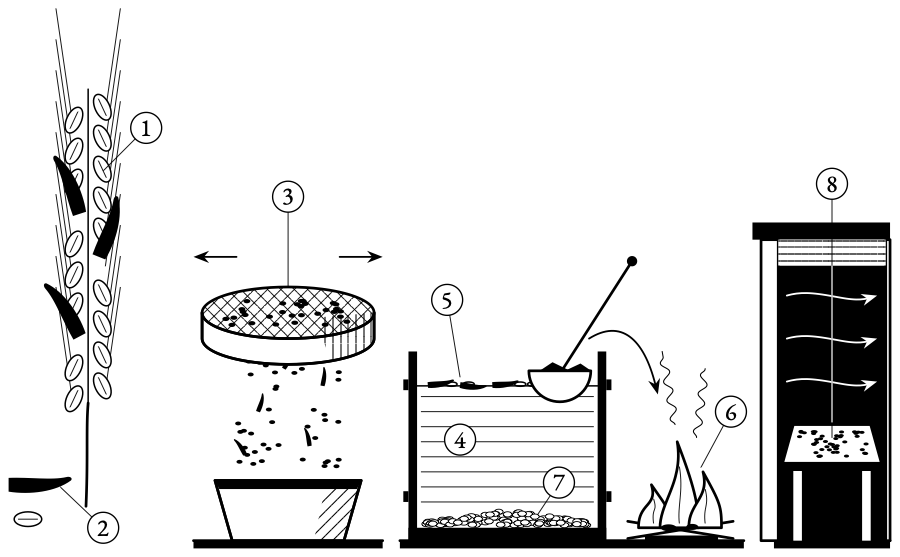
- The diseases: brine at a fifth salt, 250 g to the litre, for ergot. Mustard flour at 10 g a kilo for bunt. Vinegar at 5 % and 20 ml a kilo, or water at 53 °C for wheat and 51 for barley for 10 minutes, for loose smut. 27 124
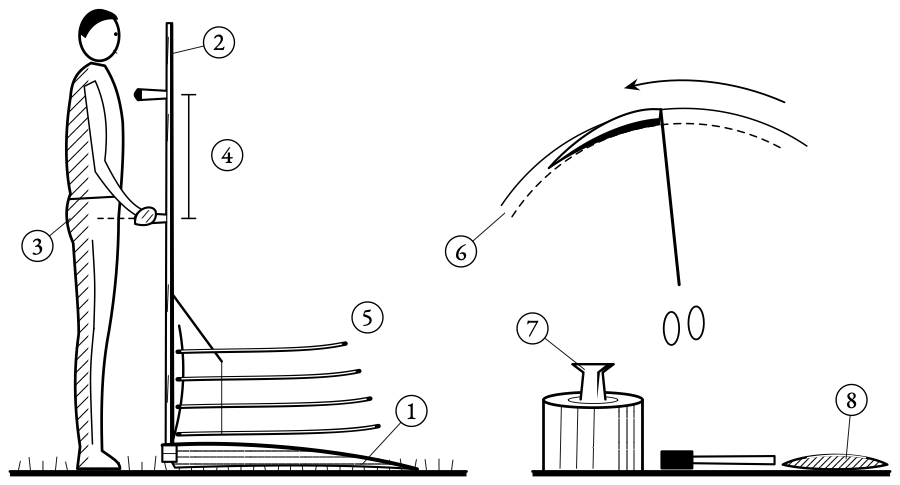
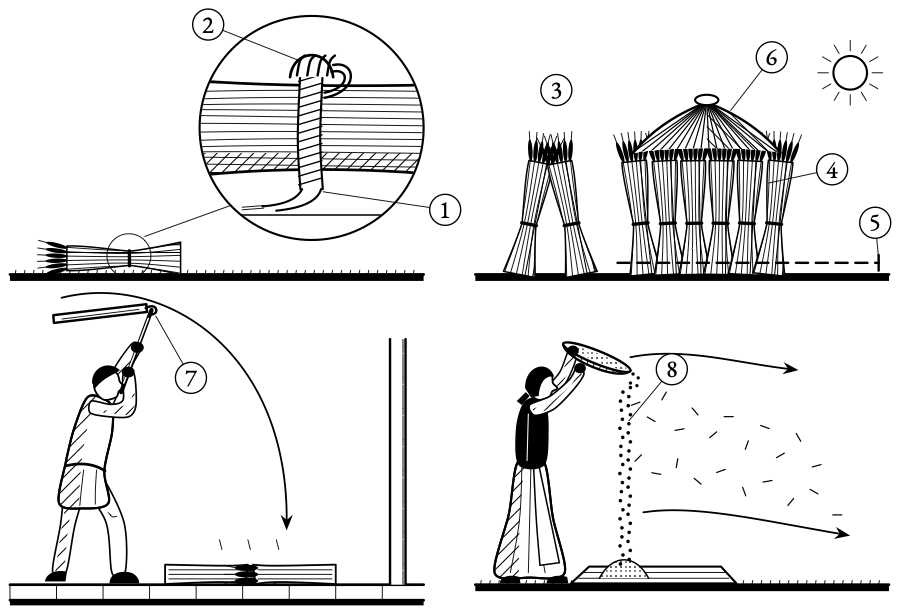
- The scythe: blade 75 to 100 cm, grip at the hip and a cubit, lay about 5 cm. Cut at 25 to 30 per cent water. Four tenths of a hectare a day. Stook 8 to 12, north and south, two to three weeks. Cart under 15 per cent. 41
- The ox: 130 hours an acre by fork, 6 by horses, 10 by oxen. Feed 80 and 60 MJ a day. Under a hectare the fork, over fifteen the team. (127, and its source is unknown)
- Spice: paprika out after 15 May at 50 cm, dried at 45 to 60 °C under 11 per cent. Cumin needs 15.5 °C soil and a dry September, which it will not get. Coriander seed 37 to 55 days after flowering, under 9 per cent. Chicory 1 cm deep, 12 to 15 by 30 to 50 cm, lifted October, never chilled, roasted at 135 to 220. 33 34
- Onions: seed 15 March to 5 April, a gram to 250 plants, 8 to 12 leaves by 21 June, bulb at 14 to 14.5 hours of day. Lift at half the tops down, cure 14 to 21 days at 24 to 27 °C under 75 % damp, store 0 to 2 °C dry. Sets bolt 15 to 40 %, seed under 1 %. Garlic 10 to 25 October at 8 to 10 °C soil. White rot: 10 kg of waste to 100 l, a week, midsummer. 132
- The garden: 25 beds of 12 m², 300 m² for four, 1,255 kg, 240 h. Frost windows 137, 163 and 206 days. Cabbage 6.5 to 9.3 kg/m², carrot 5 to 8, beet 4.8 to 7.2, squash 2.6 to 4.6, peas 2 to 3. Teltower 10 to 25 August, 60 to 75 days. 133
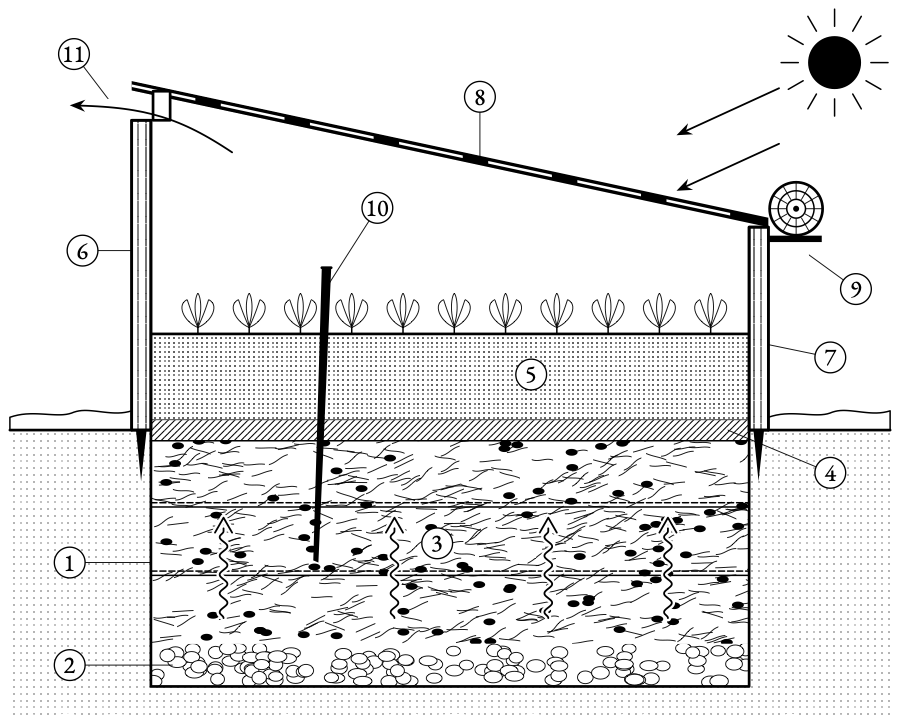
- The hotbed: 60 cm deep, 1.40 m wide, dung 45 to 50 cm, peak 60 to 70 °C by Reichart (30 to 40 by today's guides), sow when settled to about 20 after a week or two, then 20 to 28 °C for 8 to 10 weeks, sash at 35 degrees, vent above 18. 133
- Vegetable seed: bean, pea, lettuce, tomato from 20 to 50 plants a few metres apart. Onion, carrot, cabbage, beet, leek from 100 to 250 plants a kilometre or more apart, the village's. Squash 30 plants, 800 m, taste for bitter. Ferment tomato 2 to 3 days. Dry over quicklime to 6 to 7 % (tomato, carrot) or 9 to 11 % (bean, pea). Bean 3 to 5 years, pea 4 to 6, cabbage 4 to 5, onion 1 to 2. Test 2 × 50, 80 % or 70. Hot water 50 °C, 20 to 25 min. Beans soaked, then boiled hard 30 min. (134, and the FDA's half hour)
- Flax: after the rye, 130 to 150 kg/ha, 1,800 to 2,200 stems/m², 1 to 1.5 cm deep, pulled at yellow ripeness 30 to 35 days after flower. A hectare: 3,500 kg of straw, 550 kg of linseed, 150 kg of cloth, 654 h. 142
- Summer grains: millet 20 May to 5 June, 75 to 90 days, 1.5 to 2.8 t/ha. Barley 20 March to 10 April, 95 to 110 days, 2.2 to 3.5. Oats 25 March to 15 April, kilned within 48 h. Buckwheat 25 May to 10 June, 70 to 85 days, 1.0 to 1.8. Spelt and emmer October, 68 to 72 % out of the hull. Mortar 14 to 18 h per 100 kg of millet. Yields uncited. 146
The Library
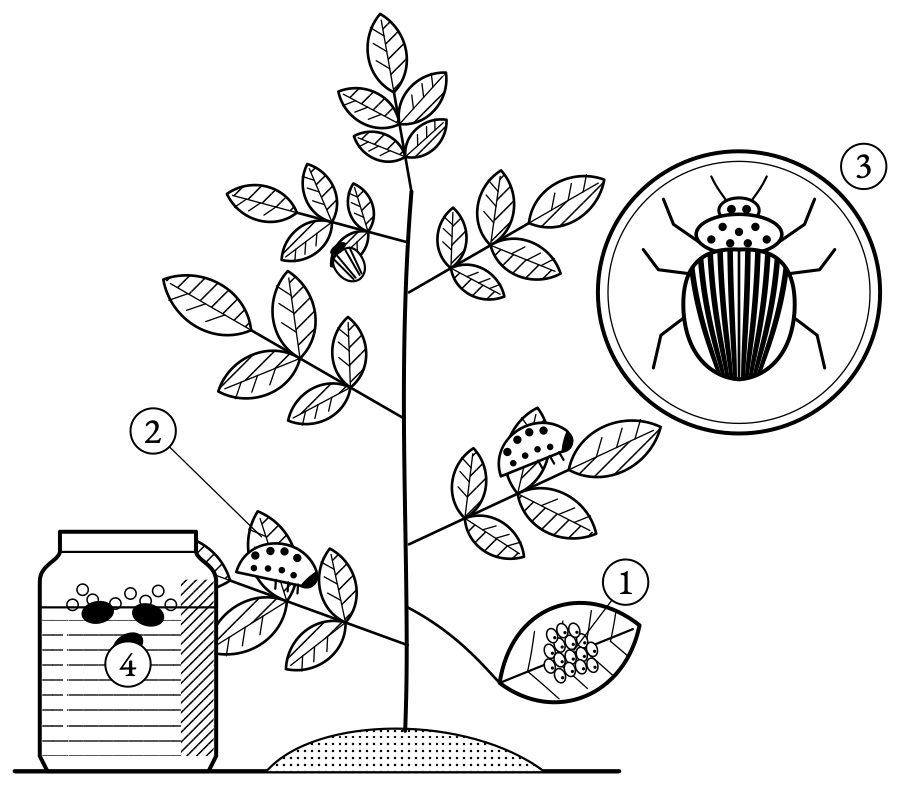
The five-year rotation, its dates, its cover crops, the crimping cue, the clubroot and scurf intervals, the rye allelopathy and the humus ledger from the rotation document (24), which every other document in this chapter cites for its Brandenburg figures, so that the twelve are in effect one witness on the sand and its climate. The two wheats, their proteins, the falling number, the harvest moisture and the granary weevil from the wheat document (26). The isolation distances, the population floors, ear-to-row, the ergot brine, the bunt and smut treatments, the germination test and the storage table from the seed document (27), and the seeding rates, the withholding scenarios, the Champagne rye and the seed law from the seed volume document (124), which rests on 27. The chickpea and bean seasons, rates, blight and harvest cues from the pulse document (29). The tomato regime, the blight defences, the varieties, Fabig and Harzfeuer, the potato routine and the heirloom potatoes from the tomato and potato document (30). The beet's sugar, its season, its ledger, its clamp and its factory from the beet document (31). Paprika, cumin and coriander, their sowing, drying and grinding from the spice document (33). Chicory and dandelion, their growing, roasting, brewing and cadmium from the root coffee document (34). The trap crops, the nets, the catnip, the nematodes and the potassium soap from the pest document (40). The scythe, its fitting, the yellow-ripe cue, the sheaf and the stook from the scythe document (41). The energy budget of the fork, the horse and the ox from the tillage document (127), which cites an unknown source for every figure in it.
Read for draft 2 on 25 September 2026:
- 132, Allium Agronomy and Seed Sovereignty. The onion's daylength, the seed-versus-set table, the Darren heat cure (from a gardeners' forum), garlic's dates and scapes, white rot and the bait, curing and storage, Elsholtz and Reichart, Werder. Its genetics and its white-rot biology rest on journals, its cultivars and its cure on vendors and forums, and its household keeps too few onions for seed.
- 133, Year-Round Kitchen Garden Protocol. The eighteen crops and their yields (from a garden app's calculator), the twenty-five beds and the 240 hours, the three frost windows (from the library's climate document), the clubroot years and pH, the hotbed (blogs, consistent with Reichart), the Teltower Rübchen and the Huguenots (Wikipedia). Its in-prose rates were lost in extraction and the table's survived.
- 134, Vegetable Seed Stewardship. The isolation and population table (Organic Seed Alliance), the biennial's clamp, the tomato ferment (a blog), quicklime and ash, the Ellis-Roberts storage table, the two-lot test, hot water, lectins and cucurbitacin (BfR, CABI), Quedlinburg and VERN. It lists Harzfeuer as open-pollinated, which the chapter does not believe.
- 146, Brandenburg Rice and Grain Substitutes. The rice verdict, the Linum trial, the summer grains' windows and yields (cited to the rotation document, which cannot hold them), the mortar and the quern and their hours. Chapter 16's document first, this chapter's second.
- 142, Brandenburg Linen and Flax Production. Flax's place after the rye in Thaer's rotation, its sowing, pulling and stooking, the hectare's balance and the village's four hectares. Uncited and consistent. The website's flax page is built from it, with Chapter 17.
The plates